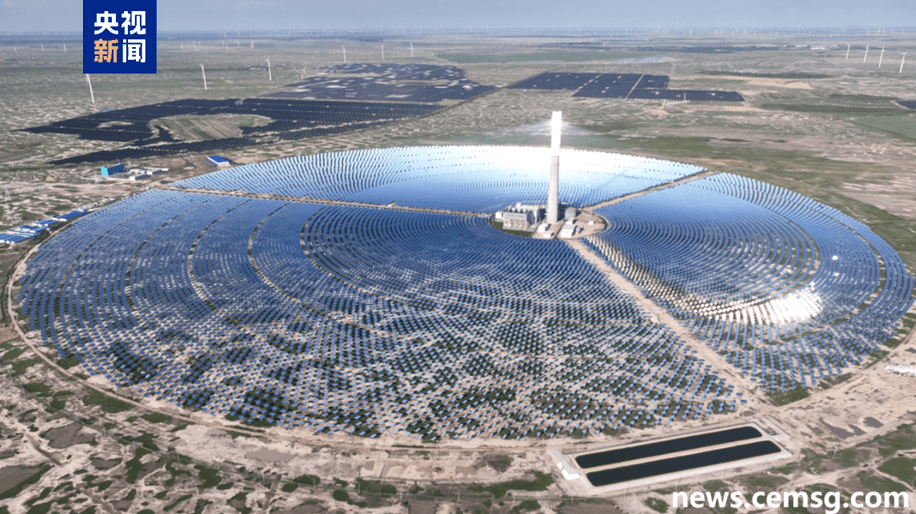
Northeast China's First Concentrated Solar Power Plant Begins Generating Electricity
CGN Jixi Base 100 MW Concentrated Solar Power Plant
On June 29, 2026, the CGN Jixi Base 100 MW Concentrated Solar Power (CSP) plant officially commenced commercial operation in Da'an City, Jilin Province, northeast China . As the region's first solar thermal power station and China's northernmost such facility, it represents a major breakthrough in CSP technology deployment in high-latitude, severely cold climates .
Technical Specifications
The plant is located at 45.36 degrees north latitude and employs a single-tower molten salt tower technology with a thermal storage capacity of up to eight hours, enabling safe, stable, and continuous 24-hour operation . The solar field comprises 19,667 high-precision heliostats with a total reflective area of approximately 590,000 square meters . These mirrors track the sun in real time and concentrate sunlight onto a 210-meter-high central receiver, where the thermal energy is converted to 565°C heat and stored in molten salt tanks .
Operational Advantages
The storage tanks have achieved better-than-expected temperature retention, allowing thermal energy to be used for same-day generation or stored for subsequent days depending on weather conditions . As one of China's first "wind-solar-thermal-storage" integrated demonstration projects in desert and Gobi regions, the plant is equipped with a 40 MW molten salt electric heater that enables coordination with adjacent 260 MW wind and 130 MW photovoltaic projects . This integration allows surplus wind and solar power to be converted into thermal energy and stored, effectively mitigating curtailment issues and improving overall energy utilization efficiency .
Engineering Challenges and Achievements
The project faced extreme conditions including temperatures as low as -37.3°C, Force 9 winds, saline-alkali soil, high groundwater levels, and heavy clay . Through systematic technological research, the project team developed key solutions for molten salt anti-freezing, wind and snow resistance for the heliostat field, low-temperature pile foundation construction, and composite waterproofing for large storage tanks . These innovations have created a standardized construction solution replicable in other frigid regions above 45 degrees north latitude .
Economic and Environmental Impact
The plant is expected to generate 180 million kWh of electricity annually, equivalent to saving approximately 54,000 tons of standard coal and reducing carbon dioxide emissions by about 139,000 tons per year . Additionally, the project has created over 2,000 local jobs during construction and operation, driving coordinated development along the industrial chain .