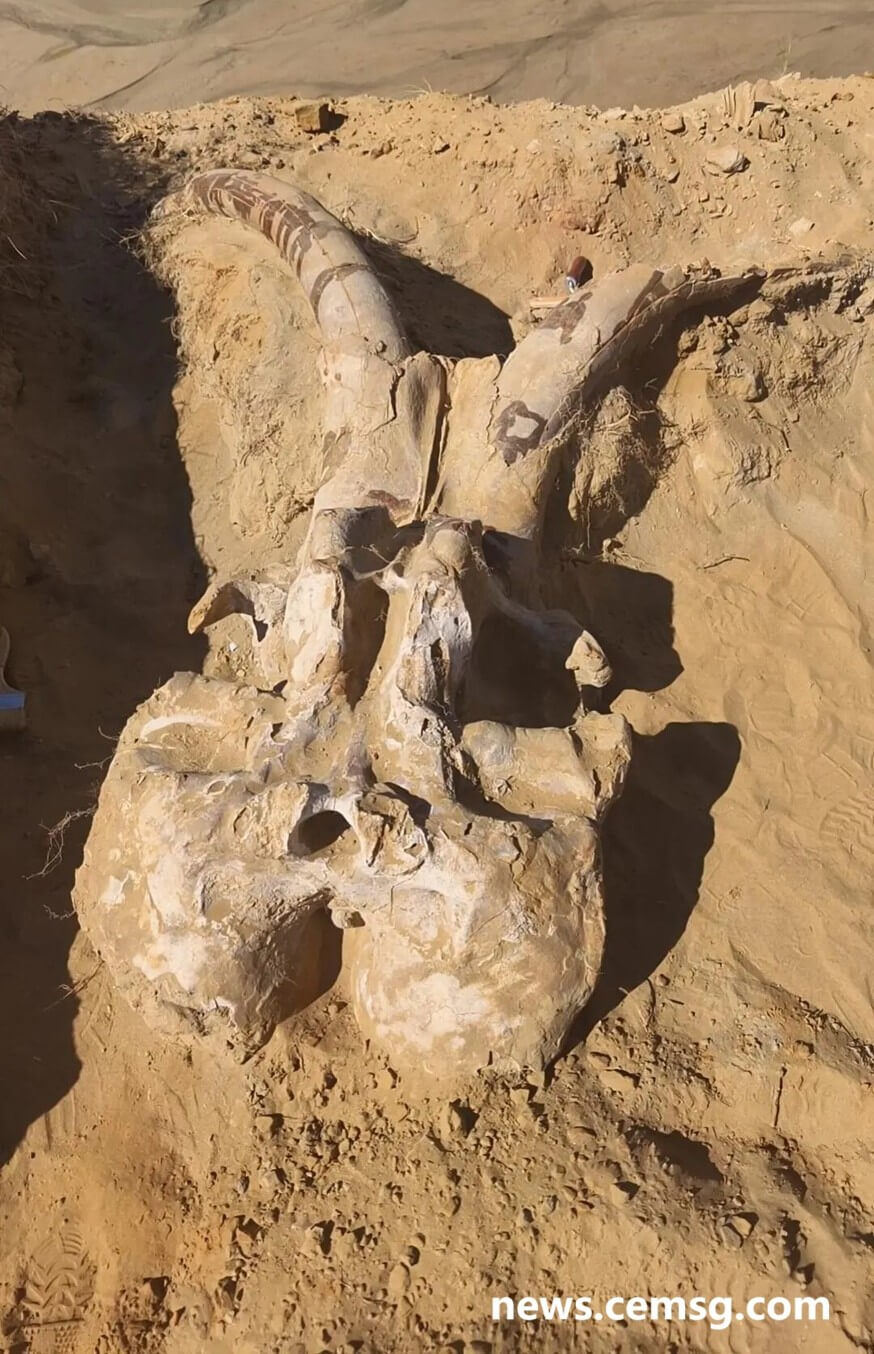
Complete Southern Mammoth Skull Fossil Discovered in Qinghai, China
An exceptionally well-preserved and nearly complete skull fossil of a southern mammoth (Mammuthus meridionalis) has been discovered in the Gonghe Basin of Qinghai Province, marking the first such discovery in China and filling a major gap in the country's fossil record for this species.
📍 Discovery and Context
The fossil was unearthed in August 2026 by a research team from the Qinghai Provincial Geological Survey Institute in Gonghe County, Hainan Tibetan Autonomous Prefecture, on the northeastern edge of the Qinghai-Xizang Plateau. The team initially spotted a 15-centimeter bone fragment half-buried in semi-consolidated sandstone and aeolian sand while tracing paleontological clues in the area.
The specimen was subsequently identified by the Institute of Vertebrate Paleontology and Paleoanthropology (IVPP) under the Chinese Academy of Sciences as belonging to the southern mammoth, dating to the Early Pleistocene, approximately 2 million to 1.3 million years ago.
🦴 Physical Characteristics
The skull is remarkably complete and well-preserved:
| Feature | Measurement |
|---|---|
| Skull Length | 75 cm |
| Skull Width | 70 cm |
| Tusk Length | 175 cm |
| Maximum Tusk Diameter | 20 cm |
| Inter-tusk Distance | 210 cm |
The skull's three-dimensional morphology is largely intact with minimal crushing deformation, and the tooth rows are complete. The M3 molar bears 14 enamel plates and lacks an intermediate conule (中间突结构), a diagnostic feature of the southern mammoth. Experts noted that the specimen is comparable to classic Italian specimens and represents a relatively advanced type within the southern mammoth's evolutionary lineage.
💎 Scientific Significance
This discovery carries multiple layers of importance, as outlined by researchers from the Qinghai geological survey:
- Filling a Domestic Gap: Previous southern mammoth fossils found in China were mostly scattered molars, incisors, and jaw fragments—no complete skull had ever been recorded. This specimen is the first complete skull of its kind in China.
- A Bridge Between East and West: The find enables the first direct comparison between East Asian and Western European skull specimens from the same evolutionary stage. It provides crucial "Eastern evidence" for verifying the southern mammoth's west-to-east dispersal route and for estimating when the species reached the northeastern margin of the Qinghai-Xizang Plateau.
- Reconstructing the Paleoenvironment: The fossil offers key vertebrate evidence for reconstructing the biological community and climate environment of the northeastern Qinghai-Xizang Plateau between 2 million and 1.3 million years ago.
- Supporting Regional Geopark Initiatives: It provides a core basis for the protection of geological heritage and the application for protected-area status in the Gonghe Basin.
🔬 Current Status and Future Research
Following excavation, the skull was consolidated, jacketed, and transported to the Qinghai Provincial Museum of Natural Resources for closed-curation storage. Associated fossils, including leg bones and rib fragments, were also found at the site and are being studied.
The research team plans to conduct meticulous specimen restoration, 3D scanning, and systematic morphological research, employing multidisciplinary analytical methods to deepen understanding of the plateau's paleoecological evolution. The broader survey project has also yielded new fossil clues for deer, bears, Sanmen horses, hyenas, elk, and fish, further enriching the record of the Early Pleistocene fauna of the Gonghe Basin.