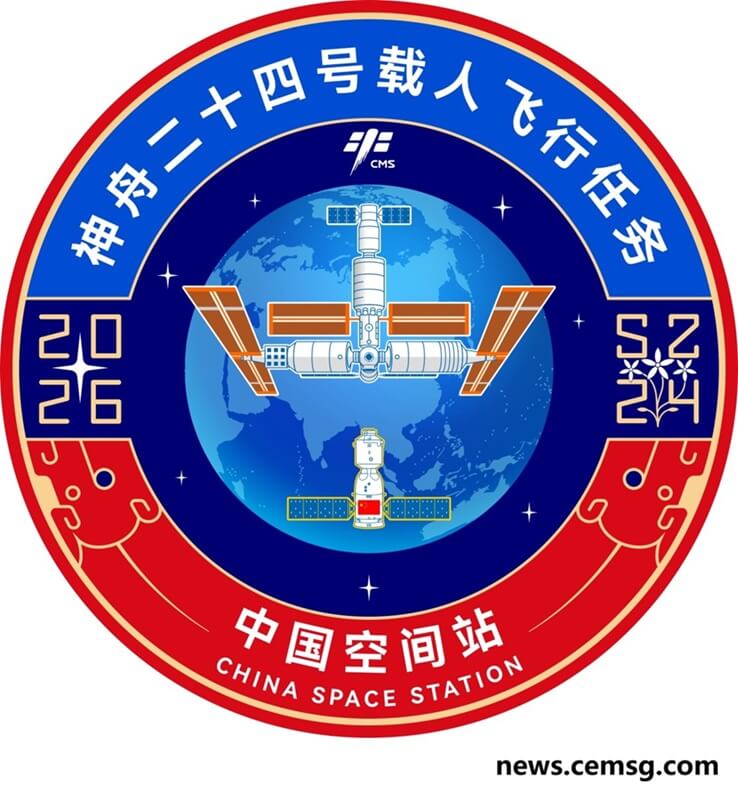
Shenzhou-24 to Be Launched in the Coming Days
China's Shenzhou-24 crewed spaceflight is in its final pre-launch phase, with the spacecraft and rocket combination transferred to the launch area at the Jiuquan Satellite Launch Center in northwest China on November 17, 2026, according to the China Manned Space Agency (CMSA). The mission is scheduled for launch in the coming days, with reports pointing to a launch window around November 25.
🚀 Launch Status
The Shenzhou-24 spacecraft and its Long March-2F Y24 carrier rocket were transported to the launch pad on the afternoon of November 17. The launch site's facilities and equipment are reported to be in good condition, and pre-launch functional checks and joint tests are proceeding as planned.
👨🚀 Crew: A Historic First
The three-person crew will include a Pakistani astronaut flying as a payload specialist, marking the first time a foreign astronaut will visit China's Tiangong space station and the first joint spaceflight involving Chinese and foreign astronauts in the history of China's space program.
The Pakistani astronaut was selected from two candidates—Muhammad Zeeshan Ali and Khurram Daud—nominated by Pakistan's space agency, SUPARCO, following a rigorous selection and training process that began with a bilateral agreement in February 2025. One will fly the mission, while the other serves as backup.
🔄 A New Rotation Model
This mission departs from the traditional "three up, three down" crew rotation. The Pakistani payload specialist will spend approximately one week aboard the station conducting scientific experiments, then return to Earth aboard the Shenzhou-23 spacecraft along with two of its crew members. One Shenzhou-23 astronaut will remain on the station for a long-duration mission exceeding one year, conducting extended in-orbit residency tests.
🛰️ Mission Objectives
The core objective is the in-orbit crew rotation at the Tiangong space station. The Shenzhou-24 crew will overlap with the outgoing Shenzhou-23 crew for about a week to complete work handovers and joint experiments before the new crew begins its own operational period. The mission marks China's 18th crewed spaceflight and continues the steady expansion of the Tiangong station's international cooperation profile.