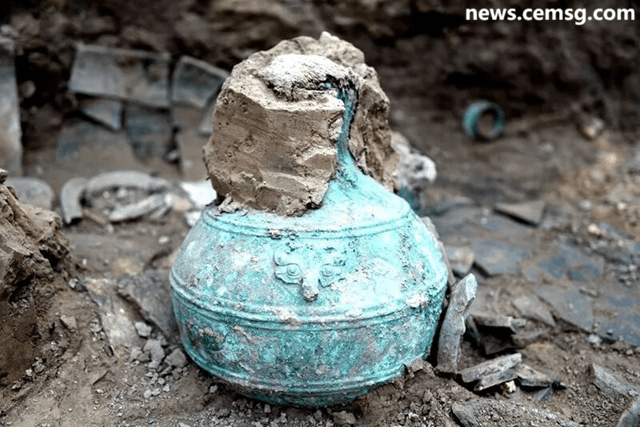
2,300-Year-Old Wine from the Warring States Period Unearthed in Guyuan, Ningxia
Chinese archaeologists have made a significant discovery at the Shanjiabao cemetery in Guyuan City, Ningxia Hui Autonomous Region, identifying a cereal-based alcoholic beverage dating back approximately 2,300 years to the Warring States period (475–221 BC) .
The Discovery
The ancient liquid was found in a garlic-shaped bronze flask (蒜头壶), a distinctive cultural artifact of the Qin state, which was unearthed from Tomb M39 at the cemetery. The site, located near the Warring States Qin Great Wall, is the largest excavated late Warring States burial ground associated with Qin culture in Ningxia, with 183 tombs discovered .
The bronze vessel's remarkable preservation is attributed to a meticulous double-sealing technique: a textile lining was applied inside, while the exterior was coated with organic mud. This effective seal minimized evaporation and contamination, allowing approximately 3,740 milliliters of liquid to remain largely intact for over two millennia .
Scientific Analysis
A multidisciplinary research team from the Ningxia Institute of Cultural Relics and Archaeology and Northwest University, led by Professor Wen Rui, conducted comprehensive analyses using advanced techniques including ultra-high performance liquid chromatography-mass spectrometry, starch grain analysis, phytolith analysis, and yeast microfossil analysis .
The researchers detected 24 classes of organic compounds, including organic acids and their derivatives, amino acids, and carbohydrates. The distribution pattern of organic acids closely resembled that found in artificially aged huangjiu (yellow wine), confirming the liquid was a deliberately brewed grain-based alcoholic beverage .
Brewing Ingredients and Techniques
Microfossil analysis further revealed that the primary brewing ingredients were broomcorn millet (Panicum miliaceum) and Triticeae grains (wheat and barley) . The findings demonstrate that the Qin people had mastered the use of qu (fermentation starter) made from moldy grains, enabling simultaneous saccharification and fermentation—a sophisticated technique that reflects the advancement of Qin-era brewing practices .
Significance
This discovery is the best-preserved liquid alcoholic beverage sample from the Warring States period ever publicly reported in China . It fills an important archaeological gap regarding brewing practices in Ningxia during the Qin period and provides rare physical evidence of grain utilization and brewing techniques among the Qin people . The findings, published in the Journal of Archaeological Science: Reports, also offer valuable insights into pre-Qin agriculture, ancient dietary culture, and the evolution of craftsmanship .