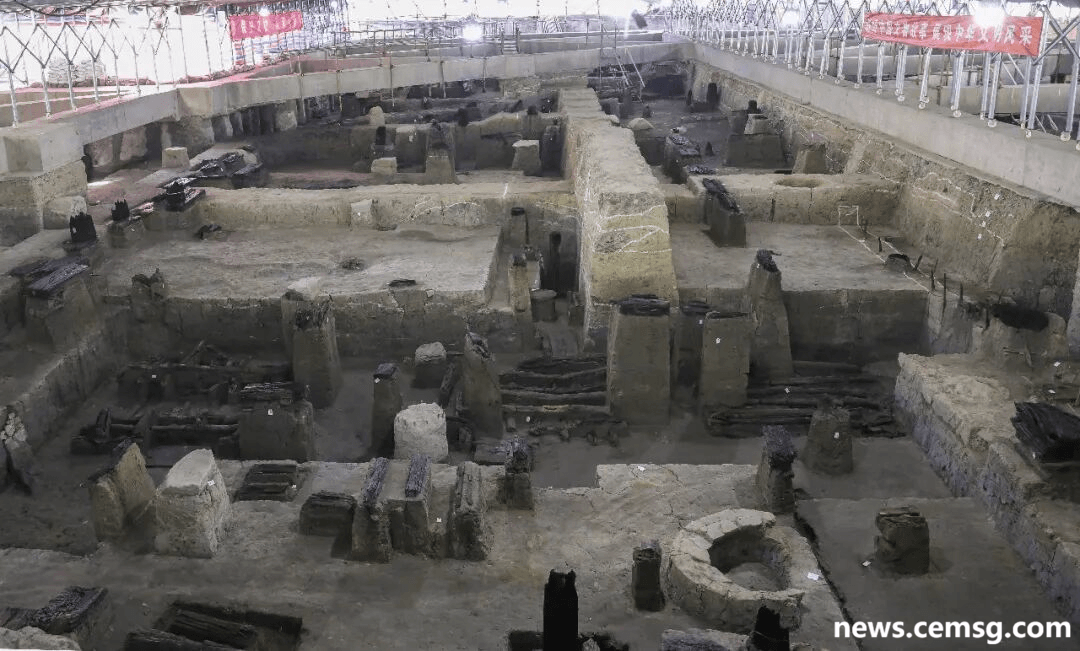
New Progress in Archaeological Excavations at King Goujian's Capital in Shaoxing, Zhejiang
New archaeological breakthroughs at the site of the Yue Kingdom capital, associated with King Goujian of Yue (reigned 496–465 BCE), have provided the first physical evidence of the city’s core area, confirming a history that was previously known only from ancient texts.
📍 The Discovery: Two Key Locations
The finds come from the Shaoxing Yue Kingdom Capital and Han-Liu Dynasties Kuaiji Commandery Site in the southern part of Shaoxing’s ancient city, Zhejiang Province. The site comprises two excavated locations: Jizhong and Tashan Hechangfang. The project, which began in 2024, has been recognized as one of China’s Top 10 Archaeological Discoveries of 2025.
🏛️ Jizhong Location: The Royal Palace
The Jizhong location is the site of a major breakthrough: the first-ever discovery of the foundation of a Yue palace terrace building.
- Scale and Structure: The building foundation lies 5–6 meters underground. It features a large-scale, east-west oriented structure measuring approximately 56 meters long and 3 meters wide, supported by a sophisticated timber foundation system.
- Innovative Engineering: The Yue builders first leveled the marshy ground with bark and wood chips, then created a "raft-like timber foundation" (筏状木构基础) by layering logs crosswise in deep trenches. Large垫板 (bearing plates) and square pillars were then erected on top. This technique, combining local stilt-style architecture with Central Plains platform-building methods, prevented pillar settlement in the wetland environment and represents a concrete example of the "diversity in unity" of Chinese civilization.
- Dating: Carbon-14 dating of the timber places the construction of this palace complex at approximately 2,500 years ago, aligning precisely with historical records that state Fan Li built the capital for Goujian.
⛩️ Tashan Hechangfang Location: Walls and Ritual Sacrifices
Located a short distance west of Jizhong, this area revealed the capital’s defensive and ceremonial infrastructure.
- The City Wall: Archaeologists uncovered the remains of the Yue Kingdom’s city wall.
- High-Grade Sacrificial Zone: The site yielded a high-status ritual area, including an earthen altar, sacrificial pits, and a 40-meter-long sacrificial trench filled with dense, layered wooden beams. This corresponds to historical records describing Goujian’s construction of a “roaming terrace” (游台) and an “spirit terrace” (灵台) on Tashan for sacrifice and astronomical observation.
- Deep History: Excavations also revealed prehistoric remains dating back over 6,000 years to the Majiabang Culture, demonstrating the deep cultural stratigraphy of the area.
🏛️ A Layered City: Han to Six Dynasties Official Remains
A distinctive feature of the site is the superposition of later remains directly above the Yue structures. At the Jizhong location, the foundations of the Kuaiji Commandery government office from the Han and Six Dynasties periods were found layered over the Yue palace. This discovery included official documents (简牍) and government-run workshop remains, providing tangible evidence of Shaoxing’s prosperity as the “leading city of the southeast” during that era.
💡 Scholarly Significance
The excavation is considered a landmark achievement. For decades, the location of Goujian’s capital was a matter of debate, supported only by textual references such as the Yuejue Shu (越绝书). The identification of a large, high-status palace complex, city walls, and a state ritual area now provides the crucial archaeological evidence that was missing. As one expert noted, the site offers a key material basis for studying the ancient southern city-building and ritual systems, and its complete stratigraphic sequence—from the Majiabang Culture through the Yue, Han-Six Dynasties, and later periods—serves as an important sample of the continuity of Chinese civilization.