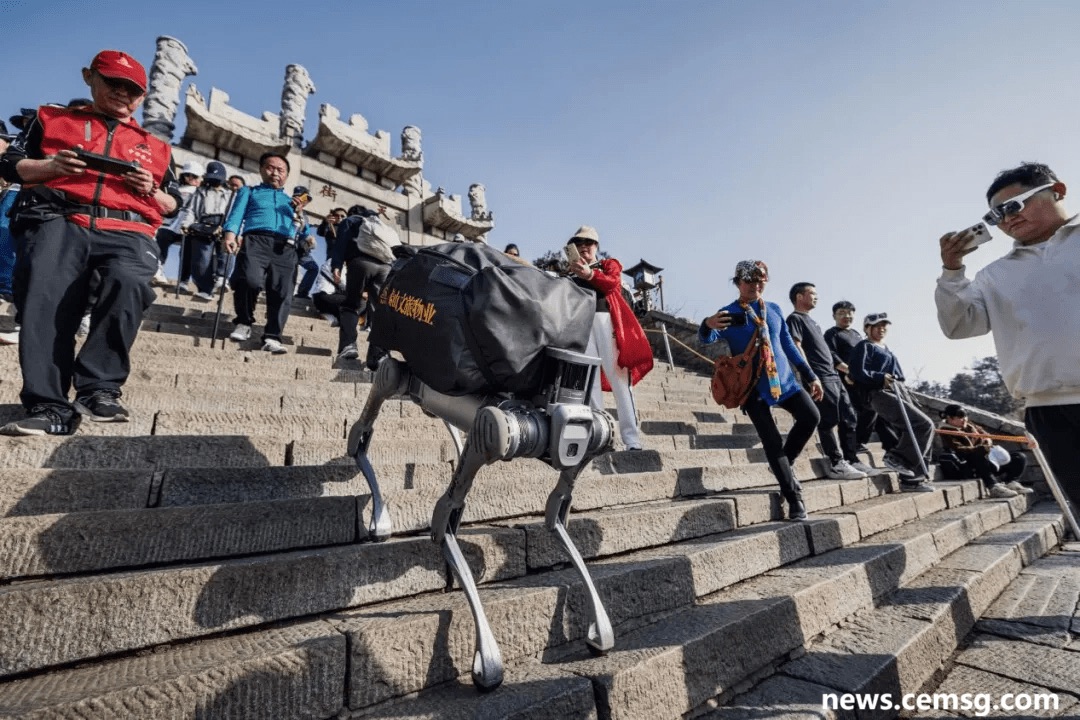
The Inaugural CMG World Robot Mount Tai Climbing Competition
The inaugural CMG World Robot Mount Tai Challenge (首届CMG世界机器人登泰山大赛) was held on November 2, 2026, in Tai'an, Shandong Province, organized by China Media Group (CMG). Nearly 90 teams from across China brought their latest robotics research to compete on one of the country's most iconic and physically demanding mountain routes.
🏔️ The Course: A Real-World Stress Test
The race was set on the ancient Hongmen–Zhongtianmen stone-paved trail, spanning approximately 3.9 kilometers with over 3,100 steps and a vertical gain of about 600 meters. The course's continuous steep staircases and sharp bends were deliberately chosen to test robots outside the controlled conditions of a laboratory, pushing their algorithms, balance, and endurance on slippery, irregular terrain.
🏁 Competition Categories
The event featured four official competitive events plus one special challenge:
- Humanoid Robot Speed Race
- Quadruped (Four-Legged) Robot Speed Race
- Quadruped Robot Load-Carrying Race
- Exoskeleton Robot Assistance Race
- All-Terrain Pathfinding Challenge (a separate exploratory event)
A qualifying round was held on October 26, with 50 teams from enterprises, universities, and research institutes competing for a place in the main event.
🏆 Key Results
| Event | Winner | Result |
|---|---|---|
| Quadruped Speed Race | Beijing Lingyi Technology | 43 min 41 sec |
| Quadruped Load-Carrying Race | Lingsi Intelligent Lingshi Team | 1 hr 51 min 29 sec (400 points) |
| Humanoid Speed Race (Main Leg: Hongmen – Doumu Gong) | Zhishen Lingyue Team | 27 min 26 sec |
| Humanoid Speed Race (Challenge Leg: Doumu Gong – Hutiange) | Zhishen Lingyue Team | 55 min 34 sec ("Peak Conqueror Award") |
Beijing Lingyi Technology, the winner of the quadruped speed race, is a subsidiary of the robotics company Unitree.
💡 Significance
The challenge served as a high-profile demonstration of China's rapidly advancing embodied intelligence and legged-robot technologies. By placing machines in a demanding, culturally iconic real-world environment, the event highlighted both the impressive progress made—one humanoid robot covered the steep main leg in under half an hour—and the practical challenges that remain for reliable locomotion in unstructured settings. It also showcased emerging applications such as load-carrying assistance and exoskeleton support, pointing toward future uses in logistics, rescue, and accessibility.