Chinese Satellite Internet Connects Earth's Three Poles in Historic First
China's domestically developed satellite internet has, for the first time, achieved connectivity across Earth's "three poles" —the Arctic, the Antarctic, and the Qinghai-Xizang (Tibetan) Plateau—successfully closing what state media described as the "last blind zone" in global communications.
📡 The Test: A Four-Way Link Across the Planet
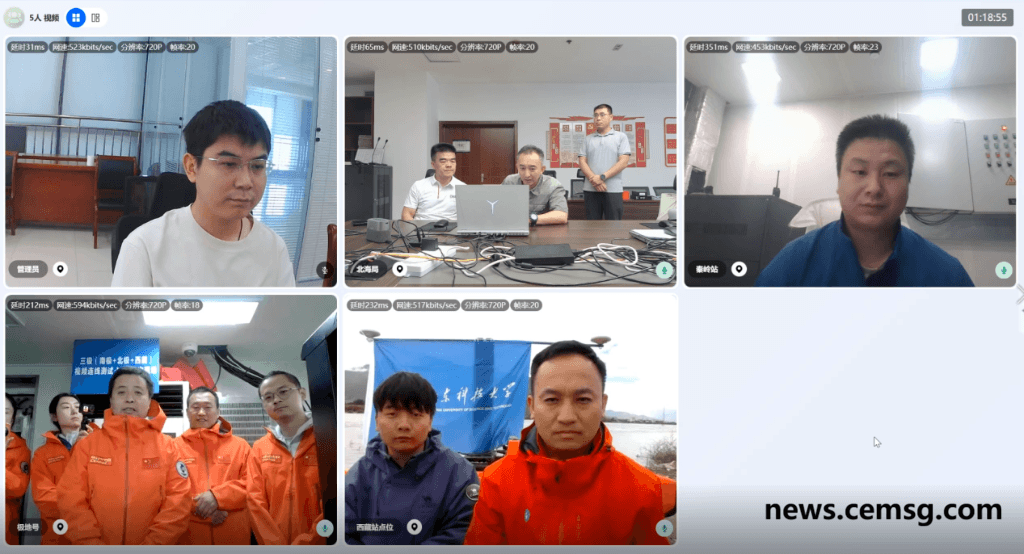
The milestone was confirmed on October 19, 2026, aboard the research vessel Jidi (Polar Region), which is currently on China's 16th Arctic scientific expedition. The vessel completed a quasi-operational application test of the domestic satellite internet along the Arctic route. The verification involved a real-time video link connecting four locations:
- The Jidi in the Arctic
- The Antarctic Qinling Station
- A test station at the Lhasa River in the Xizang Autonomous Region
- The North China Sea Bureau of the Ministry of Natural Resources
The video and voice quality was reported as clear and smooth, demonstrating low-latency, high-bandwidth communication across these remote and extreme locations.
📶 Technical Performance and the Constellation Behind It
The test was enabled by the GW Constellation (also known as Guowang), China's first mega-constellation for satellite internet, developed by China SatNet. Key performance metrics from the trial include:
- End-to-end latency: under 1 second
- Peak uplink/downlink speed: approximately 30 Mbps
- Data routing: All data was transmitted without passing through any overseas nodes, achieving full-chain, independently controllable communication for China's polar regions
- Multi-vessel access: The network connected the Xuelong, Jidi, and Tansuo Sanhao research vessels alongside the Antarctic station
The GW Constellation's multi-layer orbital architecture, Ka-band broadband payloads, and laser inter-satellite links were specifically cited as the technologies that overcome the longstanding limitation of geostationary (GEO) satellites, which cannot reliably cover latitudes above 75 degrees.
❄️ Proven Resilience in Extreme Environments
A critical outcome of the test was the validation of the system's stability under some of the harshest conditions on Earth. The equipment operated reliably in extreme low temperatures, high altitudes, strong windblown sand, and ice fog, proving its suitability for sustained use in polar and plateau environments.
Beyond the video link, the satellite internet supported a range of operational applications during the expedition:
- Remote medical support: When an expedition member fell ill, the Jidi used the satellite link to conduct a high-definition video consultation with hospitals and specialists in Qingdao, providing timely diagnosis and establishing a "lifeline" for polar medical care.
- Data transmission: The system handled over 300 file transfers totaling more than 100 GB of data, and supported more than 40 video conferences.
- Autonomous ocean sensing: Domestically developed drifting buoys transmitted data entirely through the domestic satellite network, replacing the previous reliance on international satellite systems for real-time oceanographic data.
🌍 Significance: Ending the "Information Island"
Previously, China's polar and high-altitude scientific outposts faced severe communication constraints, often described as "information islands" due to their isolation and reliance on foreign satellite networks. This test demonstrates a full-voyage communication guarantee capability based on a fully domestic satellite system.
The achievement is seen as a step toward full-chain autonomy in polar communications, creating a complementary framework of "independent and controllable" domestic coverage alongside existing international systems. It also provides a foundation for expanding satellite internet services to other hard-to-reach sectors, including emergency response and maritime operations.